

GRAPHITE TUTORIAL:
Elegy (stage two)
I don't do a lot of pre-
“Elegy” was created on 500 series Strathmore Bristol Vellum, but I’m equally fond
of the Smooth version of the paper. Vellum has subtle texture; Smooth results in
a silkier-
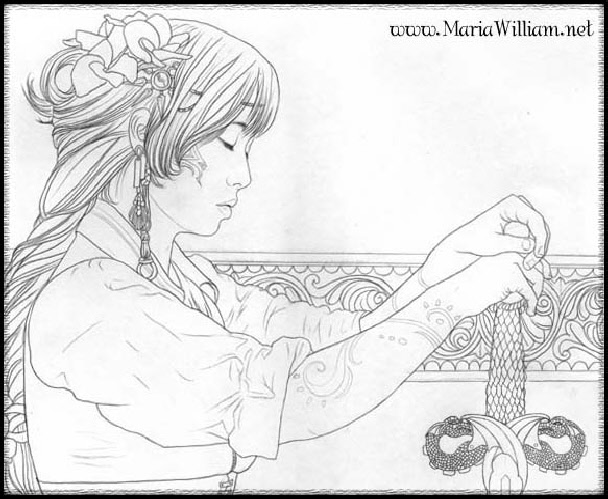
For the preliminary sketch, I used a 2B mechanical pencil, applying very light pressure so that none of the lines engraved into the paper and could later be erased easily.
When I had the composition down and all the details drawn in, I did linework using a 2B mechanical pencil. Some lines were only meant to be guides for future shading (such as the folds on the shirt sleeves) so I used a lighter grade pencil to work them over. When I was finished, I took a kneaded eraser and gently erased all the leftover sketch lines and grime that I might've added accidentally. The drawing was now ready for shading.
Of course, you can choose to skip this step if you’re looking to achieve a more realistic, less stylized look. I like to use bold lines in my work, in large part because I’m a huge fan of Art Nouveau. While I do want to maintain a certain amount of realism, at the same time I don't want my works to look like photographs.